
Play Sizzling Hot Now!
Home → Strategy
Sizzling Hot Strategy
Approaching Sizzling Hot sensibly
Sizzling Hot is an online slot developed by Novomatic that launched in 2003 with a medium volatility profile and a maximum win cap of 5000x. The theoretical return to player stands at 95.66%, which implies a house edge of 4.34% over extended play sessions compared to lower configurations. This mathematical structure means players must manage their bankroll carefully to withstand the variance inherent in this specific game design.
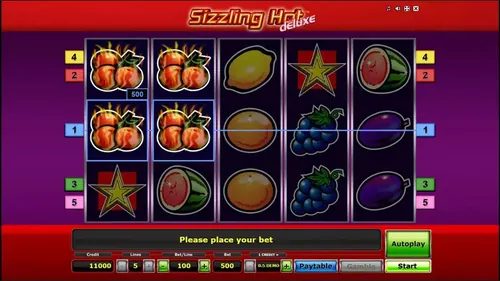
The game operates on a 5x3 reel layout with exactly five paylines, lacking wild symbols or free spin features found in modern titles like Sizzling Hot Deluxe. While Sizzling Hot Deluxe shares the same RTP of 95.66% and max win potential, it introduces additional mechanics not present in the original release. Understanding these distinct feature sets helps players set realistic expectations for payout frequency and session duration without relying on chance alone.
Bankroll rules that hold up
A flat betting strategy involves wagering the same stake every round, which prevents rapid depletion of the bankroll during cold streaks in Sizzling Hot. With a maximum win of 5000x, a player needs sufficient funds to survive the medium volatility swings before hitting a significant payout. Progressive staking methods that raise stakes after losses do not alter the built-in edge and only shorten the time to ruin significantly.
The bonus terms offer a 300% welcome bonus up to €2,000 plus 100 free spins, requiring careful calculation of total available capital for gameplay. If a player deposits €500, the bonus adds €1,500, resulting in a total bankroll of €2,000 to explore the five paylines effectively. This substantial buffer allows for more spins at standard rates, reducing the impact of the 4.34% house edge over the initial session period.
RTP represents the theoretical long-run average return over hundreds of thousands of spins, never guaranteeing short-term results for any individual gaming session. Variations exist where alternative operator builds show RTPs of 92.28% or 90.02%, which increase the house edge substantially beyond the standard 4.34%. Players should verify which version they are accessing to ensure their bankroll management aligns with the actual mathematical disadvantage presented by the game.
Bet sizing against volatility
Sizzling Hot features a Star Scatter symbol that triggers payouts but lacks the wild symbol commonly used to complete winning combinations in other slots. The absence of wilds means players must rely on matching classic fruit symbols across the five lines, affecting the hit frequency and overall win rate. This structural limitation requires bet sizing that accounts for potentially longer dry spells between successful spins compared to games with more frequent minor wins.
The maximum win potential of 5000x offers a high reward ceiling but comes with medium volatility that dictates the rhythm of payouts during play. Betting too aggressively on each of the five paylines can deplete funds quickly before the scatter or seven symbols align for a major strike. Conservative bet sizes allow the bankroll to endure the variance necessary to reach the higher multiplier thresholds defined by the game's mathematics.
Comparing Sizzling Hot to Sizzling Hot Deluxe reveals identical volatility and max win caps, yet the original version restricts players to its core five-line mechanic. Without extra wilds or complex bonus rounds, the bet size must be calibrated to the simpler symbol alignment requirements of the base game. This approach ensures that the bankroll lasts long enough to experience the full range of outcomes possible within the established 95.66% RTP framework.
Session limits worth setting
Time-based session limits help players maintain discipline when playing Sizzling Hot, preventing fatigue from influencing decisions on the five payline grid. The medium volatility means wins may come in clusters, tempting players to extend their session beyond planned boundaries in hopes of chasing further profits. Setting a strict time limit ensures that the 4.34% house edge does not erode the bankroll through excessive, uncontrolled play over many hours.
Financial loss limits should be calculated based on the initial bankroll, considering that progressive staking strategies only accelerate the depletion of funds rather than improving odds. A session limit tied to a percentage of the starting balance protects players from emotional decisions after encountering the typical variance of Novomatic slots. This disciplined approach aligns with the theoretical RTP, acknowledging that short-term results will always deviate from the long-run average significantly.
The Gamble feature offers an additional risk layer after a win, allowing players to double their payout but risking the entire amount on a coin flip. Limiting the use of this feature preserves the bankroll accumulated from the base game's five lines, preventing the quick reversal of gains. Such limits are essential given the medium volatility, as a single failed gamble can erase several small wins achieved through consistent, measured betting patterns.
Why chasing losses fails
Chasing losses in Sizzling Hot is mathematically futile because the house edge of 4.34% remains constant regardless of previous outcome history or bet adjustments. Increasing stakes after a losing streak does not change the probability of landing a Star Scatter or red Seven on the next spin across the five lines. This misconception often leads to rapid bankroll exhaustion, especially when players attempt to recover deficits using the volatile nature of the medium-variance slot.
The maximum win of 5000x is a fixed cap determined by the game's programming, meaning no amount of increased betting can unlock higher payouts or alter the return percentage. Players who chase losses often ignore the fact that alternative RTP configurations like 92.28% or 90.02% offer even worse returns if accessed inadvertently. Sticking to a predefined bankroll and flat betting strategy is the only way to manage the inherent risk associated with this specific Novomatic title.
Unlike crash games with cash-out buttons, Sizzling Hot is a traditional slot where outcomes are determined by random number generators for each spin independently. There is no mechanism to stop the reels early or mitigate losses once a spin begins, making reactive betting strategies ineffective against the house edge. Accepting the limits imposed by the 95.66% RTP and the game's structure prevents the emotional spiral that often accompanies attempts to reverse negative variance.
Sizzling Hot: key facts
| Parameter | Value |
|---|---|
| Game | Sizzling Hot |
| Studio | Novomatic |
| Released | 2003 |
| RTP | 95.66% |
| House edge | 4.34% |
| Volatility | medium |
| Max win | 5000x |
| Reels | 5x3 |
| Paylines / ways | 5 lines |
Common systems and their limits
Sizzling Hot by Novomatic features a medium volatility profile with a theoretical return to player (RTP) of 95.66%. This figure indicates that the house retains an edge of 4.34% over an extended period, which fundamentally constrains any betting strategy from achieving long-term profitability. Players relying on pattern recognition face the same mathematical barrier regardless of stake size or spin frequency.
Alternative operator builds circulate with lower RTP values of 92.28% and 90.02%, increasing the inherent house advantage significantly compared to the standard version. These variations demonstrate how platform configuration directly impacts expected loss rates without altering the core game mechanics or symbol layout. The maximum win cap remains fixed at 5000x across all configurations, capping potential payouts regardless of variance.
Unlike Indian Spirit, which also uses Novomatic technology but offers different volatility characteristics, Sizzling Hot lacks modern bonus triggers like free spins. The absence of wild symbols and reliance on classic fruit icons means wins depend entirely on random line matches rather than feature multipliers. This structural simplicity ensures consistent payout behavior but eliminates high-variance jackpot opportunities found in newer releases.
Flat betting explained
Flat betting requires maintaining the exact same stake for every round, ignoring previous outcomes or current balance fluctuations. Since Sizzling Hot operates with a fixed 5-line reel layout, this approach prevents rapid bankroll depletion during cold streaks common in medium volatility games. The strategy does not alter the built-in 4.34% house edge but extends playing time by smoothing out variance exposure.
Theoretical calculations show that consistent stakes allow players to absorb the natural drawdowns associated with a 95.66% RTP over thousands of spins. Unlike progressive methods, flat betting avoids the risk of ruin caused by escalating losses after non-winning rounds. This discipline ensures that the total amount wagered aligns closely with statistical expectations rather than emotional impulses.
Players utilizing this method must accept that the maximum win of 5000x remains a rare event unaffected by bet sizing consistency. The lack of free spins or scatter bonuses means returns come solely from base game combinations, requiring patience for significant payouts. Bankroll management becomes the primary tool for sustainability when mechanical advantages are absent.
Progressive staking risks
Progressive staking involves raising stakes after losses, a practice that accelerates bankroll exhaustion without changing the underlying mathematical expectation. In Sizzling Hot, where the RTP is 95.66%, increasing bets during downturns amplifies exposure to the 4.34% house edge significantly. This method shortens the session duration dramatically compared to fixed-stake approaches, leading to faster capital loss.
The maximum win cap of 5000x provides a hard limit on potential recovery, making aggressive stake increases mathematically unsound for long-term survival. Unlike games with unlimited jackpot potentials, the fixed ceiling means that even successful streaks cannot offset the accelerated losses from raised bets. The absence of wild symbols further restricts high-frequency winning combinations needed to sustain such strategies.
Comparison with Indian Spirit highlights how different volatility profiles affect risk tolerance, though both titles share the same developer constraints. Progressive systems fail because they assume past results influence future probabilities, which contradicts the independent nature of each spin in a certified slot. The result is often a complete depletion of funds before the theoretical average can manifest.
What the maths actually allows
The stated RTP of 95.66% represents a long-run average calculated over hundreds of thousands of spins, never a guarantee for individual sessions. This percentage implies that for every 100 units wagered, approximately 95.66 units are returned to players as winnings over time. The remaining 4.34% constitutes the casino's revenue margin, which is statistically inevitable given sufficient play volume.
Alternative versions with RTPs of 92.28% and 90.02% offer reduced returns, meaning players lose more money per unit wagered compared to the standard variant. These differences highlight the importance of verifying the specific game build before playing, as the mechanics remain identical while the payout structure varies. The medium volatility ensures that wins occur regularly but in smaller amounts relative to the stake.
The maximum win limitation of 5000x caps the highest possible payout, preventing exponential growth even during favorable variance periods. This constraint interacts with the 5-payline structure to create a predictable distribution of returns that favors conservative betting approaches. Understanding these boundaries helps players set realistic expectations regarding potential profits and loss thresholds.
Reading variance honestly
Medium volatility in Sizzling Hot balances hit frequency with payout size, avoiding the extreme swings seen in high-variance titles. This characteristic suits players seeking steady engagement rather than sporadic large wins, aligning with the classic fruit theme's nostalgic appeal. The 5-reel, 3-row layout supports this design by offering multiple ways to form winning combinations across the five paylines.
The Gamble feature introduces a secondary risk layer where players can double winnings, potentially impacting overall variance if used frequently. While this option adds excitement, it also increases the rate of bankroll fluctuation due to the binary nature of the gamble outcome. Responsible usage requires strict limits to prevent the erosion of gains achieved through base game wins.
Unlike Indian Spirit, which may exhibit different volatility behaviors despite similar technical origins, Sizzling Hot maintains a consistent risk profile throughout gameplay. The absence of complex bonus rounds simplifies variance analysis, allowing players to focus on managing their bankroll against the known house edge. Honest assessment of these factors prevents unrealistic expectations about quick wealth generation.
Learning the game in demo first
Sizzling Hot, developed by Novomatic and released in 2003, utilizes a straightforward 5x3 reel layout with exactly five paylines to structure its classic fruit symbol gameplay. The absence of wild symbols and free spins means players must rely on matching standard icons across these lines, which differs significantly from modern video slots that offer complex bonus rounds. This simplicity allows users to understand the core mechanics without confusion, unlike Alles Spitze by Merkur which features high volatility and a lower maximum win cap of 500x compared to Sizzling Hot's potential for higher returns.
Adjusting stakes to your budget
Flat betting involves wagering the same stake amount every round, which helps preserve the bankroll while navigating the medium volatility of Slicing Hot. Progressive staking strategies, which raise stakes after losses, do not alter the built-in 4.34% house edge and typically accelerate the time to ruin rather than improve outcomes. This approach contrasts with managing a bankroll for Alles Spitze, where high volatility might tempt players to adjust bets more aggressively despite the lower 500x max win potential.
Recognising a bad session
A session becomes problematic when consecutive losses deplete a significant portion of the designated bankroll, signaling that the random number generator is currently favoring the house edge of 4.34%. Unlike progressive staking systems that increase bets after losses, flat betting maintains consistency but may still result in rapid fund erosion if luck does not align with the 95.66% theoretical return. Recognizing these early warning signs prevents emotional decision-making and helps players distinguish between normal variance and unsustainable spending patterns during gameplay.
Stopping while ahead
Achieving a win that exceeds the initial bankroll presents an opportunity to secure profits before the inevitable regression toward the 95.66% RTP takes effect. Unlike progressive staking methods that encourage increasing bets after wins, maintaining a flat betting strategy helps lock in gains without exposing them to unnecessary risk. This disciplined approach contrasts with the behavior often seen in high-volatility games like Alles Spitze, where players might wait for larger payouts despite the lower 500x cap and higher variance.
DemoRTP & VolatilitySymbols & PayoutsBonus FeaturesStrategyBonusesMobileDownload & AppMax WinSimilar GamesReviewFAQSitemap
Sizzling Hot 2026